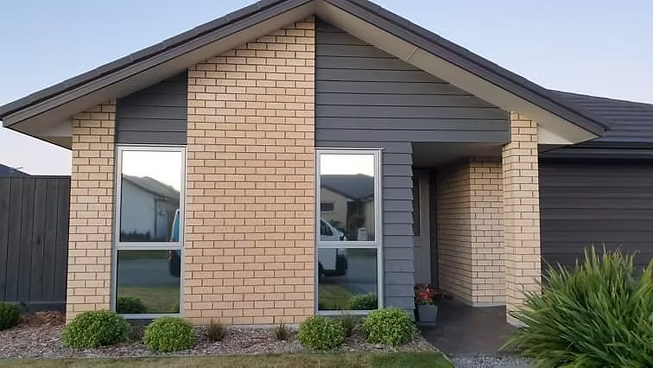

Choosing the right glass is about matching performance to place. Some glasses are built for strength and safety, others for privacy, daylight, energy savings or low maintenance. Use this guide to understand the most common types, how they differ, and where each one shines. Fun fact: as a quick weight check, glass is about 2.5 kilograms per square metre per millimetre of thickness, so 10 mm panels weigh roughly 25 kg per square metre.
Clear Float Glass

Clear float is the baseline architectural glass flat, highly clear, and low-distortion. It’s the starting point for many processed products (toughened, laminated, coated, mirrors) and delivers high daylight transmission for general glazing.
Application
Used for windows, internal partitions, and shopfronts where high visible light and a neutral look are desired. Often further processed (toughened/laminated) to meet safety requirements.
Low Iron Glass

Low iron glass removes the typical green cast of standard float, giving ultra-clear edges and true-to-colour back-painting ideal where colour fidelity or “invisible” clarity matters (thicker edges, white backgrounds, premium displays).
Application
Chosen for splashbacks, showers, showcases and signage where colour accuracy and crystal-clear edges are critical.
Laminated Glass

Laminated glass bonds two or more panes with a PVB/EVA/ionoplast interlayer. If broken, fragments adhere to the interlayer for safety; it also improves security, UV filtering and noise control. Toughened-laminated variants are used where higher loads or barrier compliance apply.
Application
Used for barriers (balconies, stairs), overhead glazing and shopfronts to meet safety/retention requirements and reduce UV fade often mandated by NZ standards and council guidance.
Tinted Glass

Tinted float is made by adding metal oxides during manufacture to produce grey, bronze, green (and other tones). It reduces solar heat gain, glare and UV while adding an aesthetic tint—often combined with other processes or coatings.
Application
Used on facades and windows to help manage solar gain and glare and to create a specific architectural look, with improved comfort and reduced fading.
Body Tints (Grey, Bronze)

Tinted (“toned”) float has colourants throughout the glass to reduce glare and solar gain while adding a consistent hue (typical tints include grey and bronze).
Variations
Used on facades and windows to help manage solar gain and glare and to create a specific architectural look, with improved comfort and reduced fading.
Acid-Etched / Frosted

Uniform acid-etched surface diffuses light for privacy while keeping interiors bright; available across common thicknesses and suitable for safety glazing when toughened.
Application
Use where soft daylight + privacy is required (bathrooms, offices, doors, partitions).
Ceramic Frit (Printed)

High-durability ceramic inks are fused to glass during heat treatment, enabling patterns, graphics and opacity control that also manage light/glare suitable inside and out.
Application
Use for patterned privacy, branding, shading and glare control on façades, spandrels, balustrades and feature walls.
Choosing confidently: quick guidance
Match glass to the risk and the result you want. Use toughened or laminated safety glass in impact zones and balustrades. Use laminated acoustic in street-facing rooms or multi-unit buildings. Use tinted or chromatic where glare and solar gain are high, self-cleaning for hard-to-reach glazing, and IGUs with low-E for energy efficiency. In wet areas and near pools, prefer laminated toughened for extra safety and keep sealants compatible with any coatings.
Care and maintenance that extend life
Clean with mild detergent and soft cloths, rinse hardware more often in coastal settings, and avoid abrasive pads that can haze coatings. Check drain holes in frames so water cannot pond, and inspect sealants annually. Small habits keep glass clear and hardware spotless for years.
In conclusion, the world of glass is vast and diverse, offering a wide range of options for various applications. Whether you’re looking for strength, safety, or aesthetic appeal, there’s a type of glass that’s perfect for your needs. Contact Royal Glass for your glass needs by sending an email to info@royalglass.co.nz or by calling 0800 769 254.